
How Many Senses Do Cats Have?
Cats are fascinating creatures with remarkable sensory abilities that help them navigate the world around them. While humans rely on five primary senses, cats possess additional unique capabilities that make them exceptional hunters and companions. Understanding their sensory strengths not only deepens our appreciation for these animals but also helps us better care for their needs.
The Five Primary Senses of Cats
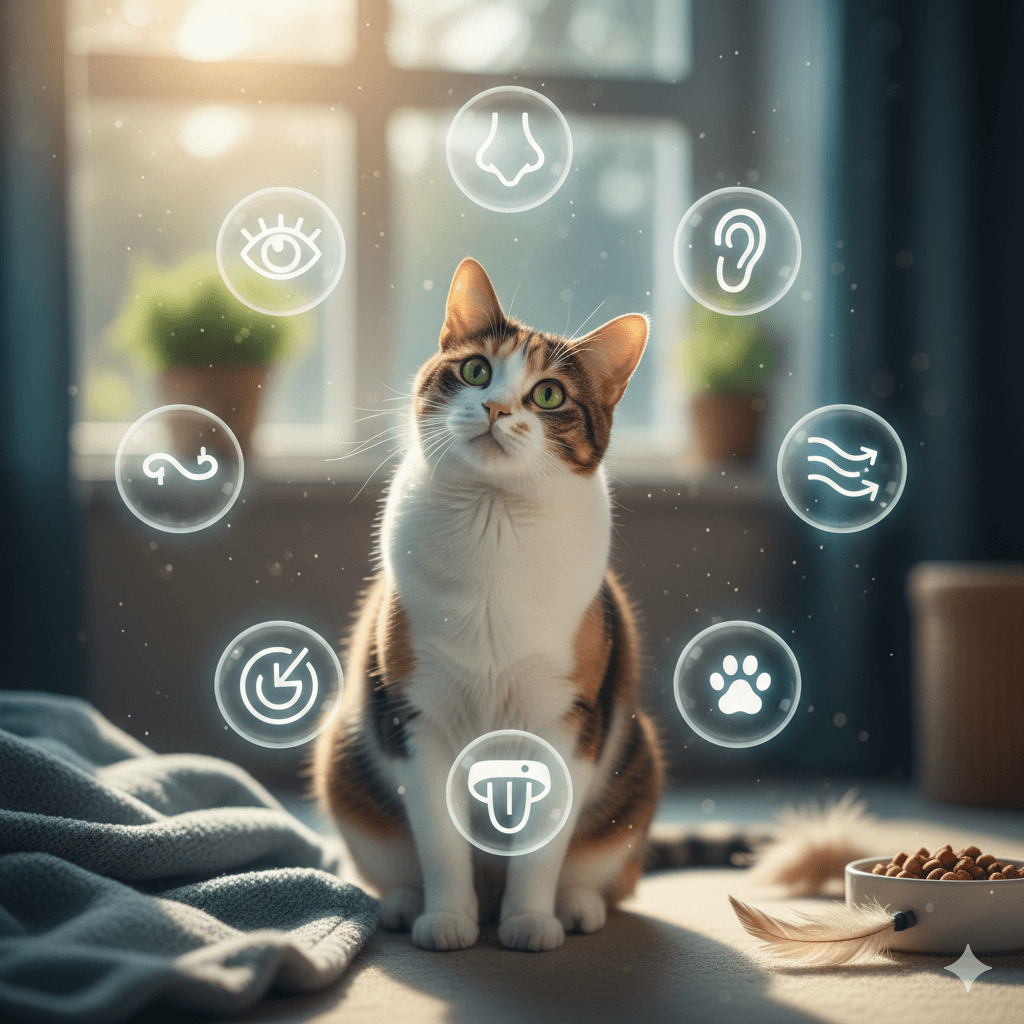
Cats, like humans, rely on five primary senses to interact with their environment: sight, hearing, smell, taste, and touch. Each of these senses is highly developed in felines, allowing them to excel as predators and adapt to various situations. Understanding how these senses function provides insight into their behavior and abilities.
- Sight:
Cats have excellent night vision due to a high number of rod cells in their retinas, which detect light and motion. Their elliptical pupils can expand widely in low-light conditions, giving them an edge during nocturnal hunts. However, their color vision is limited compared to humans—they see blues and greens but struggle with reds. - Hearing:
A cat’s hearing range extends from 48 Hz to 85 kHz, far surpassing human capabilities (20 Hz to 20 kHz). This allows them to detect ultrasonic sounds made by rodents, making them efficient hunters. Their ears are also highly mobile, rotating up to 180 degrees to pinpoint the source of a sound. - Smell:
Cats possess around 200 million olfactory receptors, significantly more than humans (5 million). This heightened sense of smell helps them identify territory, locate prey, and recognize familiar scents. They also use scent marking through glands on their face, paws, and tail to communicate with other cats. - Taste:
While cats have fewer taste buds (around 470) compared to humans (9,000), they are highly sensitive to certain flavors. For example, they lack the ability to taste sweetness due to missing genes responsible for detecting sugars. Instead, they focus on proteins and fats, which aligns with their carnivorous diet. - Touch:
A cat’s whiskers, or vibrissae, are specialized tactile hairs that act as sensory tools. These whiskers can detect subtle changes in air currents, helping them navigate tight spaces and judge distances accurately. Additionally, their paw pads contain nerve endings that provide information about texture and temperature.
These primary senses work together seamlessly, enabling cats to thrive in diverse environments while showcasing their evolutionary adaptations as skilled hunters.
The Sixth Sense: A Cat’s Vestibular System
Beyond the traditional five senses, cats possess a “sixth sense” tied to their vestibular system, which governs balance and spatial awareness. This internal compass plays a crucial role in their agility and coordination, making them masters of movement.
- Balance and Agility:
The vestibular system, located in the inner ear, helps cats maintain equilibrium. It allows them to land on their feet after a fall—a phenomenon known as the “righting reflex.” This reflex involves rapid head and body adjustments mid-air, ensuring they always land upright. - Spatial Awareness:
Cats use their vestibular system to create a mental map of their surroundings. This enables them to leap between narrow ledges, climb trees effortlessly, and navigate complex terrains without hesitation. - Head Positioning:
The vestibular system constantly sends signals to the brain about the position of the head relative to gravity. This ensures stability even when running at high speeds or jumping long distances. - Adaptation to Movement:
When a cat moves its head quickly, the vestibular system compensates by stabilizing visual input. This prevents disorientation and maintains focus on potential threats or prey. - Connection to Play Behavior:
The vestibular system also influences playful behaviors like chasing toys or pouncing. These activities mimic hunting scenarios, honing their natural instincts while relying on precise balance and coordination.
This remarkable “sixth sense” highlights why cats are so adept at navigating their world with grace and precision, even in challenging situations.
Check this guide 👉Do Cats Have a Good Sense of Smell? Best 7 Expert Tips!
Check this guide 👉Cat vs Dog Senses: Best 7 Expert Tips!
Check this guide 👉Can Cats Sense Pregnancy? Best 7 Expert Tips!
Cat Senses | Unique Features |
|---|---|
Sight | Excellent night vision, detects motion but limited color perception |
Hearing | Detects ultrasonic frequencies up to 85 kHz, far beyond human range |
Smell | 200 million olfactory receptors, uses scent marking for communication |
Taste | Cannot taste sweetness, prioritizes protein-rich foods like meat |
Touch | Whiskers act as tactile sensors, providing spatial awareness and balance |
How Cats Use Their Sense of Smell Beyond Food
A cat’s sense of smell goes far beyond identifying food. It plays a vital role in communication, territorial marking, and emotional bonding. Their olfactory prowess is one of their most powerful tools for understanding the world.
- Territorial Marking:
Cats use scent glands located on their cheeks, chin, and base of the tail to mark their territory. Rubbing against objects leaves behind pheromones that signal ownership or familiarity. - Social Communication:
Scent marking isn’t just about claiming space—it’s also used to communicate with other cats. For instance, mother cats leave scent trails for kittens to follow, creating a safe path back to the nest. - Detecting Danger:
Cats can pick up on subtle chemical changes in their environment, such as stress hormones or unfamiliar scents, alerting them to potential danger. This heightened awareness keeps them cautious and prepared. - Bonding Through Scent:
When cats rub against humans or other animals, they’re depositing their scent as a form of affection and trust. This behavior strengthens social bonds and creates a shared “group scent.” - Health Monitoring:
Changes in a cat’s own scent can indicate illness or injury. Owners may notice altered odors coming from their pet’s breath, skin, or urine, signaling the need for veterinary attention.
By leveraging their extraordinary sense of smell, cats establish connections, protect themselves, and maintain harmony within their environment.
The Role of Whiskers in Feline Sensory Perception
Whiskers, or vibrissae, are among the most fascinating sensory tools in a cat’s arsenal. These specialized hairs go far beyond simple touch, providing detailed information about their surroundings and enhancing their survival skills.
- Environmental Mapping:
Whiskers are embedded deep in a cat’s skin and connected to nerve endings that relay information about nearby objects. This allows them to “feel” their way in complete darkness or tight spaces where vision is limited. - Measuring Widths:
The length of a cat’s whiskers corresponds to the width of their body. By brushing their whiskers against openings, they determine whether they can fit through without getting stuck. - Mood Indicators:
Whisker positions reflect a cat’s emotional state. Forward-facing whiskers suggest curiosity or friendliness, while flattened whiskers indicate fear or aggression. - Prey Detection:
During hunting, whiskers help cats detect slight movements or vibrations made by prey. Even in dim light, this sensitivity ensures successful captures. - Protection Mechanism:
Whiskers act as early warning systems, triggering reflexes to protect the eyes and face. For example, if something brushes against their whiskers unexpectedly, they’ll blink or move away instinctively.
Whiskers are indispensable for cats, serving as both practical tools and indicators of their well-being.
Cats’ Enhanced Hearing Abilities Compared to Humans
Cats’ auditory system is finely tuned, surpassing human capabilities in several ways. Their acute sense of hearing is essential for survival, particularly in the wild, where it aids in hunting and avoiding predators.
- Ultrasonic Detection:
Cats can hear frequencies between 48 Hz and 85 kHz, including ultrasonic sounds emitted by small rodents. This ability gives them an advantage in locating hidden prey, even in dense vegetation. - Directional Precision:
Their independently moving ears allow them to pinpoint the exact location of a sound’s origin. This directional precision is critical for stalking prey and staying aware of their surroundings. - Selective Listening:
Cats can filter out background noise and focus on specific sounds, such as the rustling of leaves caused by a mouse. This selective listening enhances their efficiency as hunters. - Communication Through Sound:
Cats use vocalizations like purring, meowing, and hissing to express emotions and intentions. Their keen hearing also allows them to interpret similar sounds from other animals, facilitating social interactions. - Adaptation to Noisy Environments:
Even in urban settings, cats can adapt to loud noises by tuning out irrelevant sounds and focusing on what matters most, such as the approach of a predator or owner.
Their advanced hearing not only supports their predatory nature but also enriches their daily lives through nuanced auditory experiences.
The Mysteries of a Cat’s Taste Perception
While cats’ sense of taste is less developed than some of their other senses, it still plays a significant role in their dietary choices and overall health. Their unique taste preferences reflect their status as obligate carnivores.
- Limited Flavor Range:
Cats lack the genetic coding for sweet taste receptors, meaning they cannot perceive sweetness. This absence reflects their dietary focus on protein-rich foods rather than carbohydrates. - Preference for Protein:
Cats prioritize amino acids like taurine, found in meat, over other flavors. Without adequate taurine, they risk developing serious health issues, underscoring their reliance on animal-based diets. - Avoidance of Bitterness:
Bitter tastes often signal toxicity, prompting cats to avoid potentially harmful substances. This aversion helps them steer clear of poisonous plants or spoiled food. - Hydration Through Food:
Since cats naturally derive moisture from their prey, they prefer wet food over dry kibble. Texture and aroma play a larger role in their food selection than pure taste. - Individual Preferences:
Just like humans, cats develop personal likes and dislikes based on past experiences. Some may favor fish-flavored foods, while others prefer poultry or beef.
Understanding their taste perception sheds light on their dietary needs and quirks, ensuring we meet their nutritional requirements effectively.
The Emotional Impact of a Cat’s Sensory World
A cat’s sensory experiences profoundly influence their emotional well-being and behavior. By interpreting the world through their senses, they form attachments, express comfort, and manage stress.
- Comfort Through Familiar Scents:
Cats find solace in familiar smells, such as those left by their owners or household items. Introducing new scents too quickly can overwhelm them and cause anxiety. - Sound Sensitivity and Stress:
Loud or sudden noises can startle cats, leading to fear or aggression. Providing quiet spaces helps them feel secure and reduces stress levels. - Visual Stimulation and Play:
Interactive toys and windows offering views of birds or squirrels engage their visual senses, preventing boredom and promoting mental stimulation. - Touch and Affection:
Physical contact, such as gentle petting or grooming, strengthens the bond between cats and their owners. Overstimulation, however, can lead to discomfort or biting. - Routine and Predictability:
Establishing consistent routines minimizes sensory overload and fosters a sense of safety. Changes in feeding times, litter box placement, or furniture arrangement can disrupt their emotional balance.
By respecting their sensory needs, we create environments where cats feel secure, loved, and understood, ultimately enhancing their quality of life.
“Cats have the same five basic senses as humans, but they differ in function and sensitivity. Some cat senses are much stronger than human senses.”
Frequently Asked Questions About Cat Senses
How many senses do cats have?
Cats primarily rely on five senses—sight, hearing, smell, taste, and touch—but also exhibit heightened abilities like a “sixth sense” tied to their vestibular system.
Can cats see in complete darkness?
No, cats cannot see in total darkness, but their exceptional night vision allows them to detect even the faintest traces of light, giving them an edge in low-light conditions.
Why can’t cats taste sweetness?
Cats lack the genetic coding for sweet taste receptors, reflecting their evolutionary adaptation as obligate carnivores focused on protein-rich diets.
Do cats use their whiskers for anything besides touch?
Yes, whiskers help cats measure distances, detect air currents, and communicate emotions through positioning, such as forward-facing or flattened whiskers.
Are cats better at hearing than dogs?
While both animals have superior hearing compared to humans, cats can detect higher frequencies (up to 85 kHz) than dogs (up to 45 kHz), making them more sensitive to certain sounds.
Appreciating the Wonders of a Cat’s Sensory World
Understanding how many senses cats have—and how they use them—reveals the depth of their connection to the world around them. From their extraordinary night vision to their acute sense of smell and unparalleled balance, every aspect of their sensory toolkit reflects millions of years of evolution. By learning about their unique abilities, we not only deepen our bond with these incredible creatures but also ensure we provide environments that cater to their needs.
Whether it’s respecting their sensitivity to sound or appreciating the subtle ways they communicate through scent, embracing their sensory strengths enriches both their lives and ours. In the end, a cat’s senses are not just tools for survival—they’re windows into their soul, reminding us why they hold such a special place in our hearts.

Is Rawhide Bad for Cats? Best 7 Expert Tips! – Discover the risks, safe alternatives, and expert advice to keep your feline friend healthy and happy.

Is Rawhide Bad for Dogs? Best 7 Expert Tips! – Discover the risks, benefits, and safer alternatives to rawhides for your dog’s chewing needs.

Understanding Anorexia in Cats: Best 7 Expert Tips! – Learn why cats stop eating, spot warning signs, and discover how to help your feline regain appetite safely.

Understanding Anorexia in Dogs: Best 7 Expert Tips! – Learn causes, symptoms, and solutions to help your dog regain appetite and stay healthy.