
Understanding Cat Self-Awareness: A Fascinating Insight
What Is Self-Awareness in Cats?
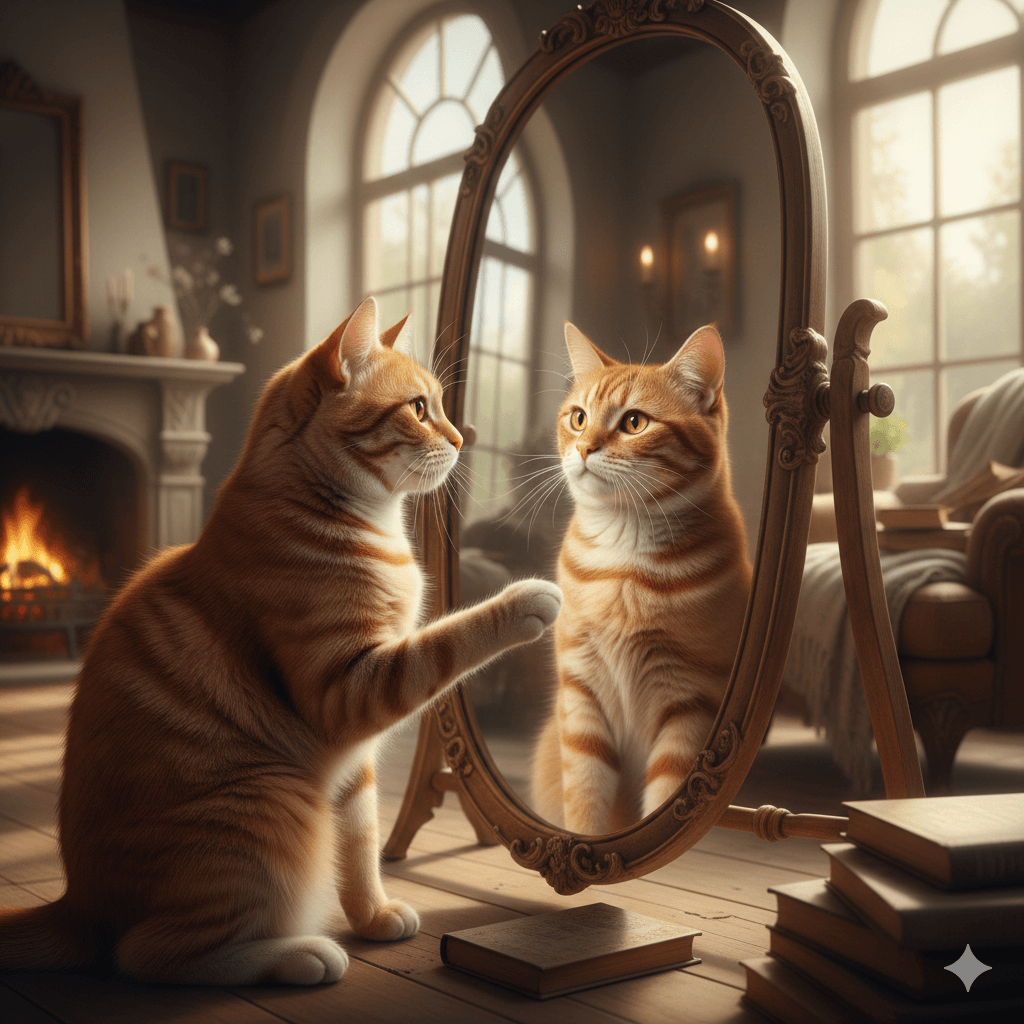
- Mirror Test Insights:
The mirror test, a common method for assessing self-awareness, involves marking an animal’s body and observing whether it recognizes the reflection as itself. Cats often fail this test, suggesting limited self-recognition. However, this doesn’t necessarily mean they lack self-awareness entirely—it may reflect different cognitive priorities. - Behavioral Observations:
Cats frequently display behaviors that hint at self-awareness, such as grooming specific areas of their body or reacting to their reflection with curiosity rather than aggression. These actions suggest some level of bodily awareness, even if not tied to visual recognition. - Unique Feline Traits:
Unlike social species, cats evolved as solitary hunters, prioritizing survival over complex social interactions. This evolutionary path may explain why their self-awareness manifests differently compared to highly social animals. - Sensory Awareness:
Cats rely heavily on scent, sound, and touch to navigate their environment. Their self-awareness might be more rooted in these senses than in visual cues, which dominate human-centered tests. - Ongoing Research:
Scientists continue studying cat cognition using alternative methods beyond the mirror test, such as problem-solving tasks and memory-based experiments, to uncover deeper insights into their self-awareness.
Signs That Suggest Cats May Have Self-Awareness
- Territorial Marking:
Cats use scent glands located on their cheeks, paws, and tail base to mark objects and spaces as “theirs.” This deliberate action suggests they recognize themselves as individuals within their territory. - Selective Grooming Habits:
When injured or dirty, cats target specific areas of their bodies for grooming. This behavior indicates they are aware of their physical condition and can locate problem spots without external guidance. - Problem-Solving Skills:
Cats demonstrate impressive problem-solving abilities when faced with challenges, such as opening doors or retrieving hidden treats. These skills require spatial awareness and an understanding of cause-and-effect relationships. - Memory Retention:
Studies show cats remember past events, locations, and routines. For example, they recall where food bowls are placed or recognize familiar voices, indicating a mental map of their environment. - Emotional Responses:
Cats exhibit emotions like jealousy, affection, or frustration based on interactions with humans and other animals. Such responses suggest they perceive themselves as separate entities capable of experiencing feelings independently.
Check this guide 👉Territorial Cat Behavior Towards Humans: Best 7 Expert Tips!
Check this guide 👉Cat Behaviorist Training: Best 7 Expert Tips!
Check this guide 👉Understanding Deaf Cat Behavior Problems: Best 7 Tips!
| Species | Key Traits of Self-Awareness |
|---|---|
| Cats | Territorial marking, selective grooming, problem-solving, memory retention. |
| Dogs | Social hierarchy recognition, human cue interpretation, strong bonding abilities. |
| Dolphins | Mirror test success, advanced communication, complex social structures. |
| Primates | Mirror test success, tool use, problem-solving, empathy toward others. |
| Birds (e.g., Crows) | Tool creation, problem-solving, memory-based navigation. |
Comparing Cat Self-Awareness to Other Animals
- Dogs vs. Cats:
Dogs excel at reading human cues and forming bonds, but their self-awareness appears tied to social hierarchies. Cats, being more independent, focus on environmental mastery rather than interpersonal dynamics. - Primates and Dolphins:
These species consistently pass the mirror test, displaying clear self-recognition. However, their social structures and reliance on visual communication contrast sharply with feline behavior. - Birds and Problem Solving:
Corvids, like crows, showcase advanced problem-solving skills similar to cats. Both species adapt to challenges creatively, though birds rely less on physicality and more on tool use. - Rodents and Memory Tests:
Rats and mice perform well in maze-based memory tests, highlighting spatial awareness. Cats share this ability but apply it differently due to their predatory instincts. - Reptiles and Minimal Cognition:
Most reptiles lack evidence of self-awareness, focusing instead on instinctual survival. Cats surpass them in cognitive complexity, particularly in decision-making and sensory processing.
How Cats Use Their Senses to Navigate Awareness
- Superior Vision:
Cats have excellent night vision and detect motion exceptionally well. While they may not recognize themselves visually, their eyesight aids navigation and hunting strategies. - Acute Hearing Abilities:
A cat’s ability to hear high-frequency sounds allows them to track prey or identify approaching threats. This auditory awareness contributes to their overall environmental consciousness. - Highly Developed Sense of Smell:
Cats use scent markers extensively to establish boundaries and communicate with others. Their olfactory system likely plays a key role in their sense of identity and territorial awareness. - Whisker Sensitivity:
Whiskers act as tactile sensors, helping cats gauge distances and textures. This heightened touch sensitivity enhances their spatial awareness and interaction with objects. - Taste and Texture Preferences:
Even taste influences a cat’s perception of its environment. For instance, they avoid bitter flavors, associating them with harmful substances—a sign of learned awareness.
The Role of Play in Demonstrating Cat Self-Awareness
- Object Manipulation:
Cats bat, chase, and carry toys, demonstrating an understanding of object permanence—the concept that items exist even when out of sight. This skill requires a degree of spatial and self-awareness. - Interactive Games:
Playing fetch or laser pointer games shows cats’ ability to anticipate movement patterns and strategize accordingly. Such activities indicate planning and goal-oriented thinking. - Social Play Dynamics:
When playing with other cats or humans, cats adjust their behavior based on the partner’s reactions. This adaptability suggests awareness of both themselves and others. - Solo Play Behavior:
Even alone, cats invent games using shadows, strings, or random objects. This creativity reflects their capacity for independent thought and exploration. - Learning Through Trial and Error:
During play, cats experiment with various approaches until they succeed. This trial-and-error process highlights problem-solving skills and self-correction.
Challenges in Measuring Cat Self-Awareness
- Limitations of Visual Tests:
Since cats prioritize scent and sound over sight, visual-based assessments like the mirror test may underestimate their self-awareness capabilities. - Lack of Social Motivation:
Unlike primates or dogs, cats aren’t driven by social rewards, making it harder to design experiments that elicit cooperative behavior. - Individual Variability:
Each cat exhibits unique personality traits, affecting how they respond to tests. Standardized measures struggle to account for this diversity. - Difficulty in Training:
Cats are notoriously challenging to train compared to dogs, complicating efforts to conduct controlled experiments requiring specific actions. - Ethical Considerations:
Researchers must balance scientific inquiry with ethical treatment, ensuring studies don’t stress or harm participating animals.
Practical Implications of Cat Self-Awareness
- Enhanced Training Techniques:
Acknowledging cats’ independence and sensory preferences leads to more effective training methods, such as positive reinforcement tailored to their needs. - Improved Veterinary Care:
Veterinarians can create less stressful environments by respecting cats’ territorial instincts and minimizing unfamiliar scents or noises. - Better Environmental Enrichment:
Providing stimulating toys, climbing structures, and hiding spots caters to cats’ natural curiosity and need for control over their space. - Stronger Human-Cat Bonds:
Recognizing cats’ emotional depth fosters empathy and patience, strengthening the bond between owners and their pets. - Future Research Opportunities:
Studying cat cognition opens doors to broader questions about animal intelligence and the evolution of self-awareness across species.
“Self-awareness is the ability to make yourself the center of your own attention. You can begin to think about yourself, not in terms of what’s happening to now, but also in relation to things that happen in the past and things that may happen in the future.”
— Gordon Gallup Jr., Emeritus Psychology Professor
Frequently Asked Questions About Cat Self-Awareness
What is the mirror test, and do cats pass it?
The mirror test assesses whether an animal recognizes its reflection as itself. Cats typically fail this test, likely due to their reliance on other senses like smell over vision.
Are cats smarter than dogs when it comes to self-awareness?
Intelligence differs between species based on evolutionary needs. While dogs excel in social cognition, cats demonstrate independence and problem-solving skills tied to their solitary nature.
Can cats recognize themselves through scent?
Yes, cats use scent marking extensively to establish territory and identity, suggesting they may have a form of self-recognition rooted in olfactory awareness.
Do cats show signs of emotional self-awareness?
Cats exhibit emotions like jealousy, affection, or frustration, indicating they perceive themselves as distinct individuals capable of experiencing feelings.
Why is studying cat self-awareness important?
Understanding feline cognition helps improve pet care, training methods, and veterinary practices while contributing to broader research on animal intelligence and evolution.
A New Perspective on Feline Intelligence

Is Rawhide Bad for Cats? Best 7 Expert Tips! – Discover the risks, safe alternatives, and expert advice to keep your feline friend healthy and happy.

Is Rawhide Bad for Dogs? Best 7 Expert Tips! – Discover the risks, benefits, and safer alternatives to rawhides for your dog’s chewing needs.

Understanding Anorexia in Cats: Best 7 Expert Tips! – Learn why cats stop eating, spot warning signs, and discover how to help your feline regain appetite safely.

Understanding Anorexia in Dogs: Best 7 Expert Tips! – Learn causes, symptoms, and solutions to help your dog regain appetite and stay healthy.