
Therapy Dog for Autism: Best 7 Expert Tips!
Welcoming a therapy dog into the life of someone with autism can bring remarkable emotional, social, and behavioral benefits. These specially trained companions offer calm presence, unconditional acceptance, and a bridge to the outside world. While not a cure, a therapy dog can be a powerful support tool—reducing anxiety, improving communication, and fostering daily routines. Choosing, training, and integrating the right dog requires thoughtful planning. With the right approach, the human-canine bond becomes a source of stability, joy, and growth for individuals on the autism spectrum.
How Therapy Dogs Support Individuals with Autism
Therapy dogs trained for autism-related support provide more than affection—they act as emotional anchors and social facilitators. Their consistent presence helps regulate sensory overload and offers nonjudgmental companionship. These benefits are backed by growing research and countless family testimonials:
- Emotional Regulation:
Dogs can sense rising anxiety or meltdowns and respond with calming pressure, nudges, or grounding contact to help de-escalate distress. - Social Catalyst:
A therapy dog often draws positive attention in public, giving the handler a natural conversation starter and reducing social isolation. - Routine Reinforcement:
Feeding, walking, and grooming the dog introduces structure, which many individuals with autism find comforting and organizing. - Sensory Integration Support:
The tactile experience of petting a dog—its warmth, rhythm of breath, and soft fur—can soothe hypersensitivity or under-responsiveness. - Safety and Wandering Prevention:
Some dogs are trained to gently block or guide a child away from unsafe situations, like running into streets or leaving supervised areas.
These roles make therapy dogs invaluable partners in daily life, helping individuals with autism feel safer, more connected, and better understood.
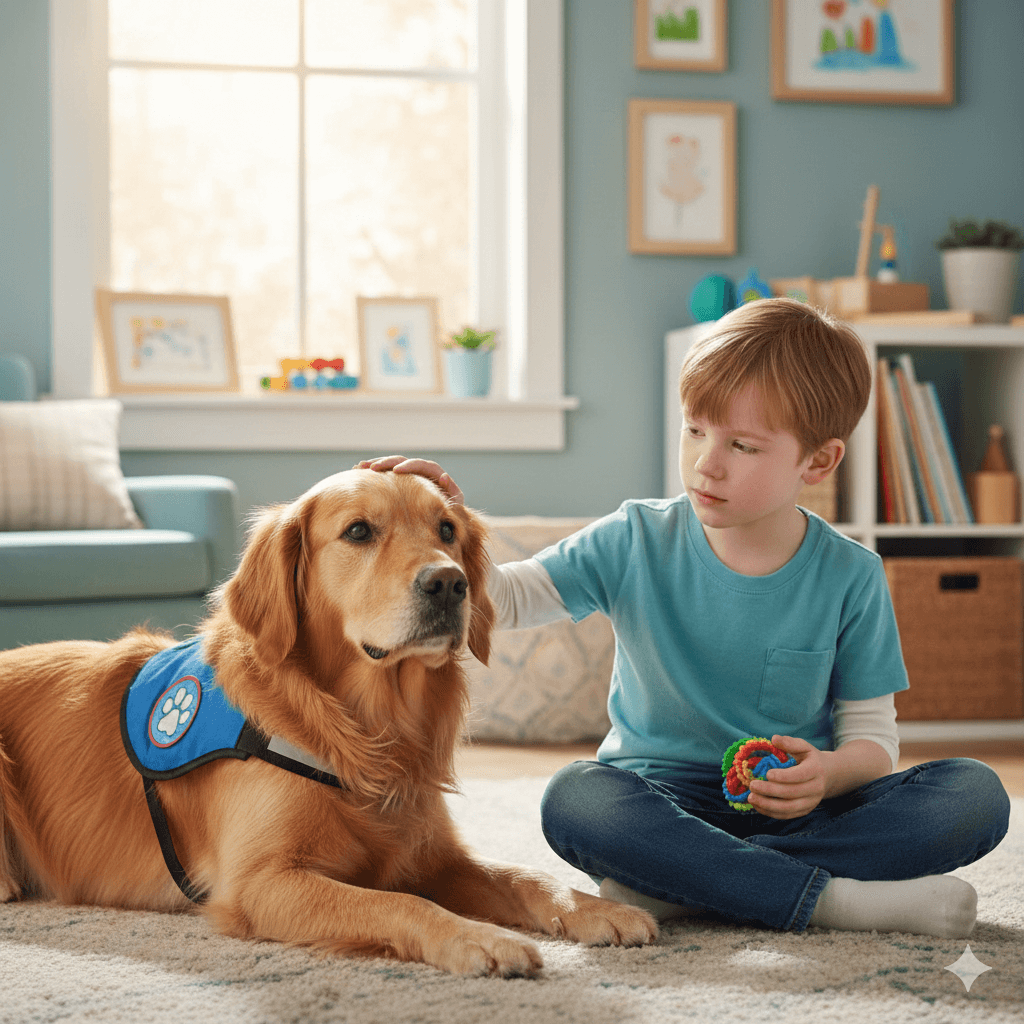
Key Qualities of an Ideal Autism Therapy Dog
Not every dog is suited for this profound responsibility. The ideal therapy dog for autism combines temperament, trainability, and resilience. Experts prioritize these traits above breed or appearance:
- Calm and Predictable Temperament:
The dog must remain composed in chaotic environments—loud noises, sudden movements, or crowded spaces—without fear or aggression. - High Tolerance for Repetitive Behaviors:
Many individuals with autism repeat actions or sounds; the dog must accept this without confusion or irritation. - Strong Focus on Handler:
Even amid distractions, the dog should maintain attention on their person, ready to respond to cues or emotional shifts. - Gentle Physical Presence:
No jumping, mouthing, or rough play—only soft, controlled interactions that won’t overwhelm sensitive individuals. - Adaptability to Sensory Challenges:
The dog should tolerate unusual handling (e.g., tight hugs, pulling ears) without reacting negatively, while still setting boundaries when needed.
Choosing a dog with these qualities dramatically increases the success and safety of the therapeutic partnership.
Check this guide 👉Can Pitbulls Be Service Dogs: Best 7 Expert Tips!
Check this guide 👉What Disabilities Qualify for a Service Dog: Best 7 Tips!
Check this guide 👉What Does a PTSD Service Dog Do? Best 7 Expert Tips!
Behavioral Strengths | Practical Care Needs |
|---|---|
Remains calm during meltdowns | Requires consistent daily exercise |
Ignores strangers unless prompted | Needs mental stimulation to prevent boredom |
Responds to subtle emotional cues | Grooming must be low-stress and routine |
Comforts without demanding attention | Thrives on predictable feeding and rest schedules |
Tolerates unusual environments (e.g., schools, malls) | Benefits from ongoing refresher training |
Selecting the Right Breed or Mix for Autism Support
While individual temperament matters more than breed, certain dogs consistently excel in autism therapy roles due to their intelligence, loyalty, and gentle nature. Consider these popular choices—but always assess the specific dog, not just the label:
- Labrador Retriever:
Friendly, eager to please, and highly trainable, Labs adapt well to families and handle sensory-rich environments calmly. - Golden Retriever:
Known for patience and empathy, Goldens bond deeply and respond intuitively to emotional shifts in their handlers. - Cavalier King Charles Spaniel:
Small, affectionate, and quiet, they’re ideal for quieter households or individuals who prefer a lap companion. - Standard Poodle:
Hypoallergenic, smart, and sensitive, Poodles excel in tasks requiring focus and adapt well to structured routines. - Mixed-Breed Rescue Dogs:
Many shelter dogs possess ideal traits; working with a reputable trainer can uncover hidden gems with the right disposition.
Remember: early socialization and professional evaluation are more important than pedigree when matching a dog to an autistic individual.
Training Essentials for Autism Therapy Dogs
Training goes far beyond basic obedience—it’s about building a responsive, reliable partnership. Certified programs typically include public access skills, task-specific behaviors, and handler bonding exercises:
- Task-Specific Skills:
Dogs may learn to interrupt repetitive behaviors, apply deep pressure therapy, or retrieve comfort items during distress. - Public Access Certification:
Dogs must master calm behavior in stores, schools, and transit—sitting quietly, ignoring distractions, and walking on a loose leash. - Handler-Focused Bonding:
Training includes joint sessions so the individual (or caregiver) can confidently guide and trust their dog in daily life. - Desensitization Protocols:
Dogs are gradually exposed to sounds (alarms, crowds), movements (wheelchairs, sudden gestures), and textures to build resilience. - Ongoing Maintenance Training:
Skills fade without practice; monthly refreshers and annual evaluations keep the dog effective and confident.
Professional guidance from organizations accredited by Assistance Dogs International (ADI) is strongly recommended for safety and legitimacy.
Legal Rights and Public Access Guidelines
Understanding legal protections ensures smooth integration of a therapy dog into school, travel, and community settings—but note critical distinctions between therapy, service, and emotional support animals:
- Service Dogs vs. Therapy Dogs:
Only psychiatric service dogs trained to perform specific tasks for autism qualify as service animals under the ADA and have full public access. - School Accommodations:
Under IDEA or Section 504, a service dog may be allowed in classrooms if it supports the student’s educational goals—documentation required. - Air Travel Rules:
The U.S. DOT now treats emotional support and therapy dogs as pets; only ADA-recognized service dogs fly in-cabin without fees. - Housing Exceptions:
The Fair Housing Act permits service and emotional support animals in no-pet housing, but therapy dogs alone may not qualify. - Certification Isn’t Legally Mandatory—but Helps:
While the ADA doesn’t require certification, vests, or ID cards, they reduce confrontations and demonstrate professionalism.
Always verify your country’s or state’s specific laws, as regulations vary widely outside the U.S.
Integrating the Dog into Daily Life and Family Routines
A successful partnership depends on thoughtful integration—not just training, but harmony within the home. The whole family often plays a role in supporting the dog’s mission:
- Establish Clear Roles:
Define who feeds, walks, and trains the dog to avoid confusion, especially if the autistic individual is a child. - Create Safe Zones:
Designate a quiet space where the dog can retreat to recharge—essential for preventing burnout in high-stimulus homes. - Involve the Individual Gradually:
Let them build trust through low-pressure interactions like brushing or giving treats before expecting full responsibility. - Monitor Dog’s Stress Signals:
Lip licking, yawning, or avoidance may indicate the dog is overwhelmed—prompting a break or routine adjustment. - Celebrate Small Wins:
Did the dog calm a meltdown? Help during a doctor’s visit? Acknowledge these moments to reinforce the bond.
When the dog becomes a natural part of the rhythm of life, its therapeutic impact deepens over time.
Benefits of a Therapy Dog for Autism Across Different Life Stages
A therapy dog’s impact evolves as the individual with autism grows—from early childhood through adulthood. At each stage, the dog adapts its support to meet changing emotional, social, and environmental needs, offering continuity in an often unpredictable world:
- Early Childhood (Ages 2–6):
The dog provides sensory comfort during meltdowns, helps establish predictable routines, and encourages early nonverbal communication through touch and eye contact. - School-Age Years (7–12):
Acts as a calming anchor in classrooms, reduces anxiety during transitions, and fosters social interaction by attracting peer interest in a non-threatening way. - Adolescence (13–18):
Offers emotional stability during hormonal and social upheaval, supports independence in public settings, and provides a judgment-free companion during identity exploration. - Young Adulthood (19–30):
Assists with navigating college, work environments, or public transport; reduces isolation and builds confidence in managing daily responsibilities. - Adulthood and Beyond (30+):
Continues to mitigate anxiety, supports community integration, and offers companionship that combats loneliness—especially for those living semi-independently or alone.
No matter the age, the therapy dog remains a consistent source of unconditional acceptance, adapting its quiet presence to meet the evolving journey of life with autism.
“Many studies show that dogs work as social catalysts by encouraging people to bond with each other.”
Frequently Asked Questions About Therapy Dogs for Autism
What’s the difference between a service dog and a therapy dog for autism?
A service dog performs trained tasks to mitigate a disability and has public access rights; a therapy dog provides comfort in settings like hospitals or schools but doesn’t have legal public access.
How long does it take to train an autism support dog?
Typically 18–24 months with professional programs, though family-trained dogs may take longer and require expert oversight.
Can a child with autism be the primary handler?
Often, a parent or aide acts as the primary handler, especially for younger children, while the dog still bonds directly with the autistic individual.
Are therapy dogs covered by insurance or government programs?
Rarely—most families fundraise, apply for grants (e.g., from 4 Paws for Ability or Autism Service Dogs of America), or pay out of pocket.
Do therapy dogs help adults with autism too?
Absolutely—adults benefit from reduced anxiety, improved social engagement, and greater independence in work or community settings.
Building a Lifelong Bridge of Trust and Calm
A therapy dog for autism is far more than a pet—it’s a quiet guardian, a steady friend, and a gentle teacher in the language of connection. The journey of bringing one into your life demands patience, planning, and partnership, but the rewards ripple through every day: a calmer morning routine, a successful school drop-off, a shared moment of silent understanding. For many families, this bond becomes a cornerstone of resilience, offering not just support, but profound joy. As you consider this path, remember that the right dog doesn’t change who your loved one is—they simply walk beside them, paw in hand, making the world feel a little safer, one step at a time.

Is Rawhide Bad for Cats? Best 7 Expert Tips! – Discover the risks, safe alternatives, and expert advice to keep your feline friend healthy and happy.

Is Rawhide Bad for Dogs? Best 7 Expert Tips! – Discover the risks, benefits, and safer alternatives to rawhides for your dog’s chewing needs.

Understanding Anorexia in Cats: Best 7 Expert Tips! – Learn why cats stop eating, spot warning signs, and discover how to help your feline regain appetite safely.

Understanding Anorexia in Dogs: Best 7 Expert Tips! – Learn causes, symptoms, and solutions to help your dog regain appetite and stay healthy.