
Understanding the Australian Dingo Dog: Best 7 Expert Tips!
Few wild canids capture the imagination like the Australian dingo—a lean, intelligent, and resilient icon of the Outback. Often misunderstood as merely a wild dog, the dingo holds a unique place in Australia’s ecological and cultural landscape. With golden eyes, a sleek coat, and an air of quiet independence, this animal bridges the gap between domestication and true wilderness. Whether you’re curious about its behavior, history, or conservation, these expert insights will deepen your appreciation for one of nature’s most fascinating canines.
Origins and Evolutionary History
The dingo’s lineage stretches back thousands of years, making it far more than just a feral offshoot of domestic dogs. Genetic and archaeological evidence paints a complex picture of migration, adaptation, and isolation. Its journey to becoming an apex predator in Australia is a story of survival in one of Earth’s harshest environments:
- Ancient Asian Ancestry:
DNA studies show dingoes descend from East Asian domestic dogs that arrived in Australia over 3,500 years ago, likely brought by seafaring traders. - Long-Term Isolation:
Once in Australia, dingoes bred in near-complete genetic isolation, developing distinct traits separate from modern domestic dogs. - No True Domestication:
Unlike village dogs, dingoes were never selectively bred by humans, preserving wild instincts and behaviors for millennia. - Role in Indigenous Culture:
Aboriginal Australians formed symbiotic relationships with dingoes, using them for warmth, hunting, and spiritual companionship without full domestication. - Genetic Purity Under Threat:
Today, hybridization with feral domestic dogs is the greatest threat to the “pure” dingo genome, especially near urban areas.
This remarkable evolutionary path makes the dingo not just a dog—but a living relic of ancient canine history.
Distinctive Physical and Behavioral Traits
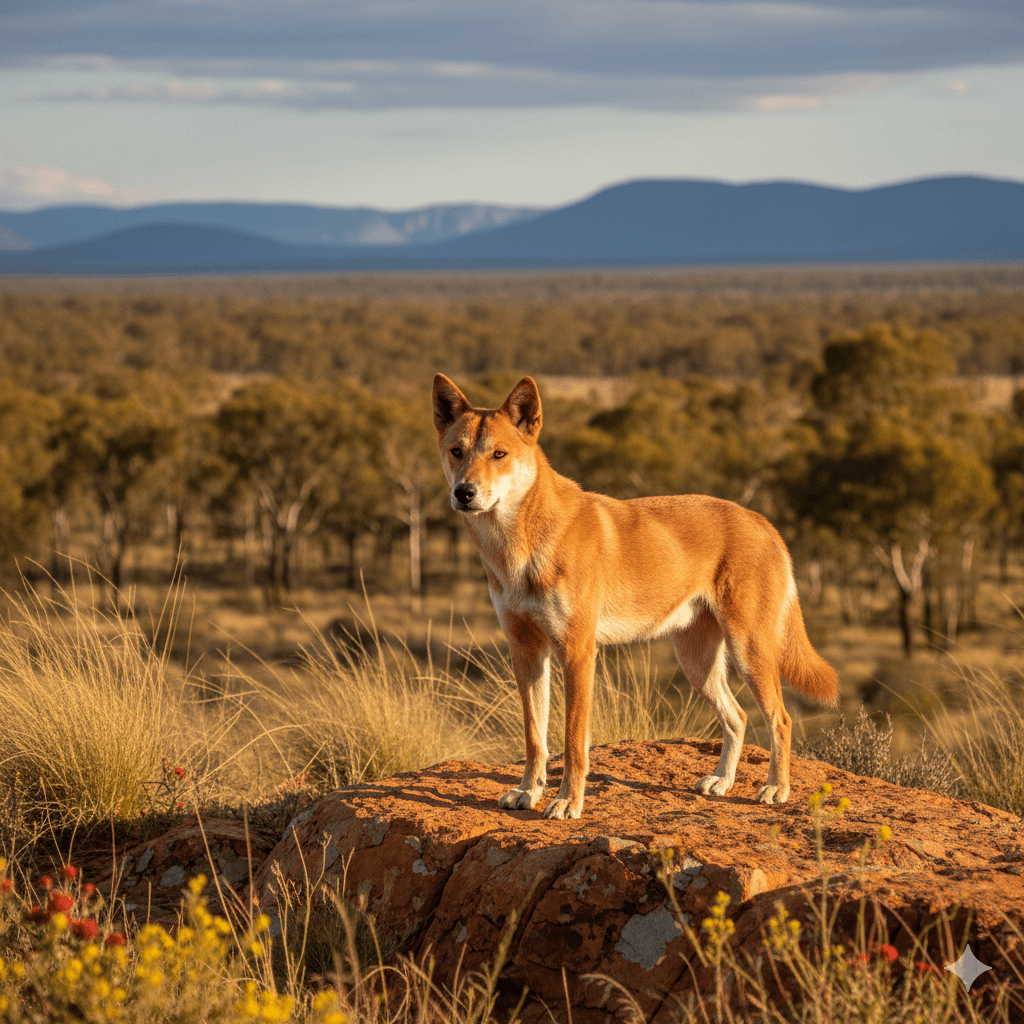
The dingo’s appearance and demeanor reflect its role as a solitary, efficient hunter shaped by the Australian wilderness. Sleek and athletic, it carries itself with a quiet confidence that sets it apart from both wolves and domestic breeds:
- Lean, Muscular Build:
Weighing 22–33 lbs (10–15 kg), dingoes have a narrow chest, strong legs, and a flexible spine ideal for speed and endurance. - Coat Color and Texture:
Typically ginger or sandy with white markings on feet, tail tip, and chest; the coat is short and dense, shedding seasonally. - Unique Tail and Ears:
The bushy tail is carried low, and large, erect ears enhance acute hearing—critical for detecting prey in sparse terrain. - Solitary Yet Social in Packs:
While often seen alone, dingoes form tight-knit packs during breeding season, led by an alpha pair with strong territorial instincts. - Vocal Restraint:
Unlike domestic dogs, dingoes rarely bark; they communicate through howls, yelps, and body language, especially at dusk.
These traits aren’t just aesthetic—they’re survival adaptations honed over centuries of life in the wild.
Check this guide 👉Blue Heeler vs Australian Cattle Dog: Best 7 Expert Tips!
Check this guide 👉Australian Cattle Dog Life Expectancy: Best 7 Expert Tips!
Check this guide 👉The Australian Water Dog: Best 7 Expert Tips!
| Wild Instincts | Human Interaction Realities |
|---|---|
| High prey drive – hunts rabbits, kangaroos, rodents | Not suitable as typical household pets |
| Territorial marking with scent and howling | Requires experienced, knowledgeable caretakers |
| Seasonal breeding (once per year) | Cannot be reliably house-trained like domestic dogs |
| Problem-solving intelligence | May escape enclosures with ease |
| Strong pack loyalty in wild settings | Forms deep but independent bonds |
Ecological Role and Environmental Impact
In Australia’s fragile ecosystems, the dingo serves as a keystone predator—its presence shapes the entire landscape. Far from being a pest, scientific research increasingly shows that healthy dingo populations support biodiversity and even protect native species:
- Natural Pest Control:
By preying on invasive foxes and feral cats, dingoes indirectly shield small marsupials and ground-nesting birds from extinction. - Herbivore Population Balance:
Dingoes help regulate overabundant kangaroo and wallaby numbers, preventing overgrazing and soil erosion. - Trophic Cascade Effects:
Areas with stable dingo packs often show richer plant diversity and healthier riverbanks due to reduced herbivore pressure. - Competition with Livestock Farmers:
Despite ecological benefits, dingoes sometimes attack sheep, leading to conflict and lethal control measures like the Dingo Fence. - Climate Resilience:
Their adaptability to deserts, forests, and alpine zones makes them vital indicators of environmental change and habitat health.
Rather than eliminate them, many conservationists now advocate coexistence strategies that honor their ecological value.
Legal Status and Conservation Challenges
The dingo’s legal standing varies wildly across Australia—protected in some regions, declared vermin in others. This inconsistency complicates efforts to preserve genetically pure populations and maintain ecological balance:
- State-by-State Regulations:
In Queensland and the Northern Territory, dingoes are protected in national parks; in New South Wales and South Australia, landowners may cull them freely. - The Dingo Fence Dilemma:
Stretching over 5,600 km, this barrier protects sheep farms but fragments dingo territories, reducing genetic diversity and disrupting natural behaviors. - Hybridization Crisis:
Up to 80% of “dingoes” near cities are hybrids, diluting the gene pool and blurring conservation definitions. - Captive Breeding Ethics:
Sanctuaries and zoos work to maintain pure lines, but ethical debates continue about removing wild animals for conservation. - Public Misconceptions:
Many still view dingoes as dangerous pests, despite low aggression toward humans and critical environmental roles.
Conservation success hinges on shifting public perception and implementing science-based management policies.
Caring for a Dingo in Captivity (Rare and Regulated)
While strongly discouraged as pets, a few licensed individuals and facilities do care for dingoes under strict permits. This requires extraordinary commitment, space, and expertise—far beyond typical dog ownership:
- Specialized Enclosures:
Needs large, escape-proof outdoor spaces with natural terrain, shade, and denning areas; standard kennels are inadequate. - Dietary Requirements:
Thrives on raw, species-appropriate diets including whole prey, bones, and organ meats—commercial kibble is insufficient long-term. - Mental Stimulation:
Without complex enrichment (scent trails, puzzle feeders, foraging opportunities), dingoes develop stress and destructive behaviors. - Limited Socialization Windows:
Even hand-raised pups retain wild instincts; they do not respond to obedience training like domestic dogs. - Legal Permits Mandatory:
Ownership is illegal without government authorization, which is rarely granted and subject to rigorous inspections.
Caring for a dingo is less like owning a pet and more like stewarding a wild ambassador.
Training and Behavior: What’s Possible?
Training a dingo operates on entirely different principles than training a Labrador or Border Collie. Their intelligence is undeniable—but it serves independence, not compliance. Success depends on understanding their motivations:
- No Traditional Obedience:
Commands like “sit” or “stay” are rarely reliable; dingoes choose whether to cooperate based on trust, not dominance. - Positive Reinforcement Only:
Harsh methods backfire instantly; they respond best to food rewards, quiet praise, and consistent routines. - Strong Recall is Unlikely:
Even bonded dingoes may ignore calls if prey or scent trails capture their attention—never assume off-leash safety. - Early Socialization is Crucial (But Not Sufficient):
Exposure to people and environments as a pup helps, but wild instincts remain dominant into adulthood. - Body Language Mastery:
Owners must learn subtle dingo signals—ear flicks, tail twitches, lip licks—to anticipate needs and avoid conflict.
Working with a dingo means adapting to them, not the other way around.
Unique Traits That Set the Australian Dingo Apart
Beyond its ecological role and wild heritage, the Australian dingo possesses several lesser-known traits that distinguish it from all other canids—domestic or wild. These characteristics reflect its singular evolutionary path and adaptation to Australia’s diverse landscapes:
- No Paw Pad Sweat Glands:
Unlike domestic dogs, dingoes lack sweat glands in their paw pads, relying instead on panting and behavioral cooling (like digging in cool earth) to regulate body temperature. - Self-Cleaning Coat:
Their short, dense double coat naturally repels dirt and parasites, reducing the need for frequent grooming—a clear advantage in remote habitats. - Seasonal Monogamy:
Dingoes typically form strong, temporary pair bonds during breeding season, with both parents participating in pup rearing—a rare trait among wild canids. - Exceptional Navigation Skills:
Studies show dingoes can travel vast distances across featureless deserts using environmental cues like stars, wind patterns, and scent trails. - Silent Stalking Technique:
When hunting, dingoes move with near-silent precision, placing paws carefully to avoid twigs or dry leaves—an evolved skill for ambushing wary prey.
These subtle yet remarkable adaptations underscore why the dingo is not merely a “wild dog,” but a uniquely Australian marvel shaped by isolation and survival.
“Rather than prioritising ‘purity’, future conservation efforts should focus on maintaining large enough populations for natural selection to operate effectively. This will ensure that dingoes can maintain their position as Australia’s apex predator.” — Dr Lachie Scarsbrook
Frequently Asked Questions About the Australian Dingo
Are dingoes dangerous to humans?
Attacks are extremely rare and usually linked to habituation (e.g., feeding by tourists). Wild dingoes naturally avoid people.
Can you domesticate a dingo like a dog?
No—domestication takes thousands of years of selective breeding. Dingoes remain genetically and behaviorally wild.
How is a dingo different from a wolf?
Smaller than wolves, dingoes have a more slender build, different vocalizations, and no pack hierarchy as rigid as wolves’.
Do dingoes bark?
Rarely. They primarily howl, especially at night, to communicate over long distances.
Is the dingo a separate species?
Taxonomically debated—it’s classified as Canis lupus dingo or Canis dingo, but genetically distinct from both wolves and domestic dogs.
Honoring the Spirit of the Australian Wild
The Australian dingo is more than an animal—it’s a symbol of resilience, mystery, and ecological harmony. To reduce it to a “wild dog” is to overlook its profound role in shaping Australia’s natural balance and Indigenous heritage. While it may never fetch a ball or sleep at your feet, its quiet presence under the stars reminds us of the wild heart that still beats beneath the surface of our modern world. Protecting the dingo isn’t just about saving a species; it’s about preserving a living connection to the ancient rhythms of the land. In learning to respect its boundaries, we honor not only the dingo—but the wildness we all carry within.

Is Rawhide Bad for Cats? Best 7 Expert Tips! – Discover the risks, safe alternatives, and expert advice to keep your feline friend healthy and happy.

Is Rawhide Bad for Dogs? Best 7 Expert Tips! – Discover the risks, benefits, and safer alternatives to rawhides for your dog’s chewing needs.

Understanding Anorexia in Cats: Best 7 Expert Tips! – Learn why cats stop eating, spot warning signs, and discover how to help your feline regain appetite safely.

Understanding Anorexia in Dogs: Best 7 Expert Tips! – Learn causes, symptoms, and solutions to help your dog regain appetite and stay healthy.